Elastic Width Guide (5 mm to 100 mm) for Garment Manufacturers
By Jai Roop Textile ·
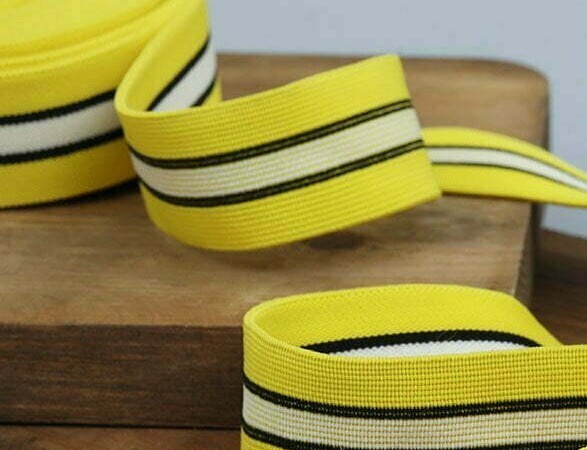
Width is the most common thing buyers get wrong on an elastic order — too narrow and the waistband digs in, too wide and the garment looks bulky or costs more than it should. At Jai Roop Textile we weave elastic from 5 mm to 100 mm in Gurugram, so we see every width in daily production. Here is how the ranges are typically used.
Width ranges and typical uses
| Width | Where it is commonly used | Notes |
|---|---|---|
| 5 – 8 mm | Lingerie straps, face-mask ear loops, sleeve and leg openings, gathering | Usually knitted for softness; woven for firm loops |
| 10 – 15 mm | Kids' wear, innerwear waistbands, cuffs, shirring | Button-hole elastic for adjustable kids' waists is typically in this range |
| 20 – 30 mm | Standard trouser, skirt, pyjama and boxer waistbands | The most ordered range; 25 mm is the common default |
| 32 – 50 mm | Sportswear, leggings, athleisure, branded jacquard waistbands | Jacquard logos read best at 32 mm and above |
| 50 – 75 mm | Medical belts, back and knee supports, maternity bands | Woven for firm, stable support |
| 75 – 100 mm | Industrial straps, luggage, furniture, orthopaedic products | Heavier construction; specify tension needs |
How to specify an elastic correctly
A good specification saves a round of samples. Send us these six points with every enquiry:
- Width in mm (relaxed).
- Construction — woven or knitted (see our woven vs knitted guide).
- Stretch % — how much it should extend (e.g. 100% means 10 cm stretches to 20 cm).
- Colour — white, black, or a Pantone / swatch for dyed elastic.
- Finish — plain, soft-back, latex-free, or jacquard pattern.
- Quantity in metres and your delivery location.
Common mistakes we help buyers avoid
- Measuring a stretched sample. Always measure width when the elastic is relaxed on a flat table.
- Ordering by "inch" habits. 1 inch is 25.4 mm; 1.5 inch is 38 mm. Confirm the mm figure in writing.
- Ignoring the casing. If the elastic goes inside a fabric casing, the casing must be a few mm wider than the elastic or it will bunch.
- Choosing width by look alone. Heavier garments need firmer, wider elastic to hold — not just to look right.
Custom widths
Because we weave on our own machines in Gurugram, non-standard widths are normal for us — we regularly produce widths between the common sizes for brands with specific patterns. Minimum quantities depend on width and construction, so share your requirement and we will confirm.
Frequently asked questions
What is the most common elastic width for trouser waistbands?
Around 25 mm is the most commonly ordered width for standard trouser, skirt and pyjama waistbands. Heavier garments and sportswear often move up to 32–40 mm.
Do you make elastic wider than 50 mm?
Yes. Jai Roop Textile weaves elastic up to 100 mm wide, which is used for medical belts, supports, maternity bands and industrial straps.
Can I get a width that is not standard?
Yes. Custom widths between the standard sizes are produced regularly; minimum quantity depends on the width and construction, which we confirm at quotation.
How do I measure elastic width correctly?
Measure the elastic relaxed, lying flat, in millimetres. Never measure it while stretched — width reduces under tension, especially for knitted elastic.
Need Woven Elastic in bulk?
Custom widths, colours and designs for garment exporters, brands and wholesalers. Share your requirement and we will get back with a quote.